.png)
ATV vs. UTV vs. Side-by-Side Which Off-Road Vehicle Is Right for You
ATVs, UTVs, and side-by-sides for sale in Ontario range from compact single-rider trail machines to six-seat family rigs capable of hauling gear across rough terrain, and choosing the wrong one for your riding style is one of the most common mistakes first-time buyers make.
The terms ATV, UTV, and side-by-side get used interchangeably in conversation, but they describe genuinely different vehicles with different capabilities, seat configurations, and legal statuses on Ontario trails. Before you start comparing models or visiting a dealer, it is worth understanding exactly what separates them, and which category fits what you actually plan to do with it.
This guide covers the key differences, walks through the best options for families, solo riders, and trail explorers across Ontario, and explains what you need to know about licensing and trail access before you buy.
ATV vs. UTV vs. Side-by-Side: A Practical Comparison for Ontario Buyers
The Three Vehicles, Defined
Understanding the difference starts with the basics.
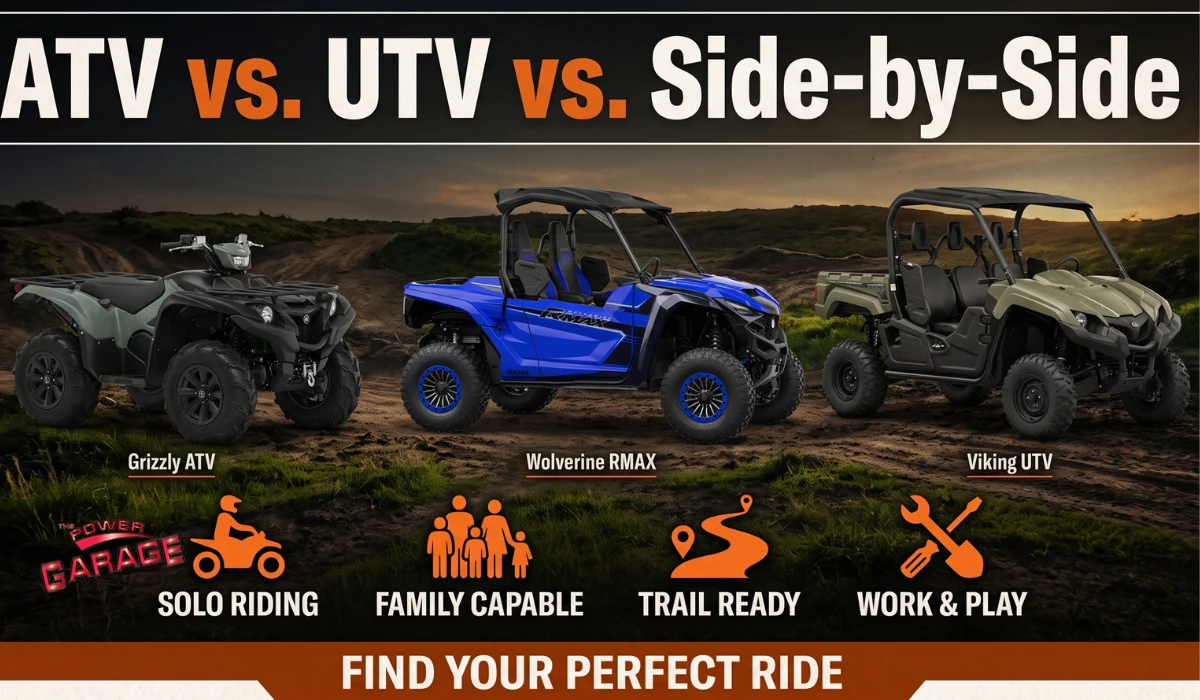
An ATV (All-Terrain Vehicle) is a single-rider, straddle-seat vehicle with handlebars. They are the most compact option, highly maneuverable, and well-suited for tight trails, hunting property, and solo riding. Ontario classifies ATVs as off-road vehicles under the Off-Road Vehicles Act, meaning they require registration, a driver's licence, and a valid off-road vehicle permit to ride on designated public land or club trails.
A UTV (Utility Task Vehicle) is a side-by-side seating vehicle with a steering wheel and roll cage, designed for two or more passengers. UTVs typically offer more cargo capacity, more stability, and more comfort than ATVs. They are the preferred choice for work applications and family riding alike.
Side-by-side is not a separate category. It is a common name for UTVs, referring to the seating configuration where passengers sit beside each other rather than in a front-to-back arrangement. When someone says side-by-side, they mean a UTV. The terms are interchangeable, though manufacturers and enthusiasts use both.
Head-to-Head Comparison: ATV vs. UTV / Side-by-Side
Here is how the two categories compare across the factors that matter most to Ontario buyers:
| Factor | ATV | UTV / Side-by-Side | Notes for Ontario Buyers |
|---|---|---|---|
| Seating | 1 rider | 2 to 6 passengers | Most families buying for group use choose a UTV |
| Steering | Handlebars | Steering wheel | UTVs feel more like a car and are easier for new riders |
| Trail agility | High - very maneuverable in tight terrain | Moderate - wider footprint | ATVs access narrow trails many UTVs cannot navigate |
| Cargo capacity | Minimal (racks only) | High (bed + cab storage) | UTVs are far more practical for hauling gear or supplies |
| Stability | Rider-dependent - requires active balance | High - four-wheel base, roll cage | UTVs are significantly safer for passengers |
| Purchase price | Lower entry point | Higher - varies by seat count and features | Both categories have wide price ranges |
| Ontario licensing | Driver's licence + OHV permit required | Driver's licence + OHV permit required | Same regulatory requirements for both categories |
| Best for | Solo riding, hunting, tight trails | Families, mixed terrain, work use, group riding | Purpose is the deciding factor, not price |
The Family Buyer's Guide: 2-Person, 4-Person, and 6-Person Options
For families shopping side-by-sides for sale in Ontario, seating capacity is usually the first filter. Here is what to look for at each seat count:
| Seating | What to Look For |
|---|---|
| 2-Person | Entry-level UTVs in this category offer excellent value. Look for models with a tilt bed, adequate ground clearance for Ontario's mixed trail conditions, and enough horsepower for loaded use. A good starting point for couples or riders who plan to upgrade later. |
| 4-Person (most popular for families) |
The sweet spot for most Ontario families. Brands like Yamaha and Kawasaki offer four-seat configurations that balance interior space with trail capability. Look for rear seatbelts, a ROPS-certified roll cage, and models with the option to fold rear seats for additional cargo space. |
| 6-Person | Designed for larger groups and serious trail riding. These are longer, wider, and require more clearance on narrow trail systems. Confirm that the trails you plan to ride allow vehicles of this width before purchasing. |
Buying tip for families: Choose one seat more than you think you need. Kids grow, friends come along, and the gear pile always expands. Buyers who go with a 2-seater when a 4-seater was within budget consistently wish they had stretched.
Ontario Licensing and Trail Access: What You Need to Know Before You Buy
Ontario's Off-Road Vehicles Act governs where and how ATVs and UTVs can be operated on public land. Getting this wrong leads to fines, liability issues, and vehicles that cannot legally access the trails you bought them for.
| Requirement | Details for Ontario Riders |
|---|---|
| Driver's licence | A valid Ontario driver's licence is required to operate any ATV or UTV on public land or designated trail systems. The vehicle classification is separate from the licence class required. |
| OHV permit | An Ontario Off-Highway Vehicle (OHV) permit is required for all ATVs and UTVs operating on Crown land, OHV trails, or roads where permitted. Annual permits are available through the Ontario Federation of ATV Clubs (OFATV) or equivalent organizations. |
| Vehicle registration | All ATVs and UTVs must be registered with the Ministry of Transportation Ontario (MTO) and display a valid licence plate. |
| Trail width restrictions | Many Ontario trail systems have maximum width restrictions, typically 50 to 60 inches, that exclude wider UTVs. Confirm the specifications for your specific trail system before purchasing a wide-body side-by-side. |
| Age restrictions | Riders under 16 cannot operate an ATV or UTV on public land without adult supervision in Ontario. Specific rules apply to riders under 12. |
| Helmet requirement | Helmets are mandatory for all ATV operators and passengers in Ontario, regardless of age. |
Ontario Trail Access Note: The Ontario Federation of ATV Clubs (OFATV) manages over 20,000 kilometres of designated trail in Ontario. Trail access requires a valid OFATV membership in addition to your OHV permit. Check current trail maps and width restrictions at ofatv.org before finalizing your vehicle choice.
Which Vehicle Is Actually Right for You?
The decision usually comes down to three questions: How many people are coming? How are you planning to use it? Where are you riding?
If the answer is solo riding on tight trails or hunting property, an ATV is likely the better fit. They are lighter, more nimble, and lower cost. If the answer involves passengers, mixed use, hauling gear, or family trail days, a UTV or side-by-side is the practical choice for almost every Ontario buyer.
The brands we carry at The Power Garage reflect both needs. Yamaha and Kawasaki both offer strong lineups in the ATV and UTV categories, with models suited to everything from recreational trail riding to more demanding work applications.
Browse our current off-road vehicle inventory to compare models side by side, or use our full inventory search to filter by seat count, brand, or price range.
Have questions about which model fits your trail system or riding style? Our service and sales team in Woodstock can walk you through the options in person.
Frequently Asked Questions
What is the difference between a UTV and a side-by-side?
There is no difference. Side-by-side is a colloquial term for a UTV (Utility Task Vehicle), referring to the side-by-side seating configuration. Manufacturers, dealers, and riders use both terms interchangeably. If you see a vehicle listed as a side-by-side for sale in Ontario, it is a UTV.
Do I need a licence to drive a side-by-side in Ontario?
Yes. Operating a UTV or ATV on public land, Crown land, or designated OHV trails in Ontario requires a valid driver's licence, a registered vehicle, and an OHV permit. A valid OFATV trail membership is also required to access Ontario's designated ATV trail network. Operating without these on public land can result in significant fines.
What is the best side-by-side for families in Ontario?
For most Ontario families, a four-seat UTV with a certified roll cage, rear seatbelts, adequate ground clearance, and at least 500cc of engine displacement is the right starting point. Yamaha and Kawasaki both offer family-oriented models in this range. The right choice depends on your trail system, your typical group size, and whether you plan to use the vehicle for any work or utility applications alongside recreation.
Can a side-by-side access all Ontario ATV trails?
Not always. Many Ontario ATV trail systems have maximum vehicle width restrictions, typically between 50 and 60 inches. Some wider side-by-sides exceed these limits and may be restricted from certain trail networks. Always confirm the width specifications of your intended trails against the vehicle's specs before purchasing a wide-body UTV.
How do I finance an ATV or side-by-side in Ontario?
Most dealerships, including The Power Garage, offer financing options for ATVs and UTVs. Yamaha Financial Services is available on eligible Yamaha models and offers competitive terms. Having a sense of your budget range, anticipated down payment, and preferred term length before visiting a dealer will speed the process significantly.
Ready to Find Your Ride?
Browse our off-road inventory at The Power Garage in Woodstock, Ontario, or talk to our team about financing and trade-in options.
.png)

.png)